Showing posts with label Horror. Show all posts

Monday, 16 July 2012

Videodrome (1983)

Starring:  James Woods, Deborah Harry, Peter Dvorsky, Sonja Smits

Directed by: David Cronenberg

Written by: David Cronenberg

Duration: 1hr 24 mins

Rating: 5 out of 5


‘Video’ and ‘drome’.  Have two unrelated nouns ever been combined to create such an ominous-sounding compound?  And just try explaining the movie’s plot without making it sound like the nauseating fantasy of a sick mind (and thus labelling yourself a deviant pervert by association): 

“Max Renn (James Woods), an executive at a sleazy late-night cable TV channel, is always looking for the next edgy product to unleash upon his titillation-hungry viewers.  Whilst scanning the airwaves for illegal content he picks up a transmission containing the most extreme show he’s ever seen:  ‘Videodrome’.  Eschewing niceties like introduction, premise or context, it is simply hour upon hour of a single red room where people are bound, tortured and humiliated.   Renn is hooked and quickly becomes obsessed.  The show turns out to genuinely dangerous:  it’s not staged at all but for real – snuff TV – and worse still is actually a mind-control device that quickly begins to corrode first Renn's brain and then his body.  As our hero descends deeper into a hallucinogenic nightmare, he discovers that Videodrome is part of a grander scheme of mass manipulation involving a deceased professor who only exists via hundreds of video recordings and is the patriarch of a spectacles firm that is actually a front for a NATO weapons manufacturer.”

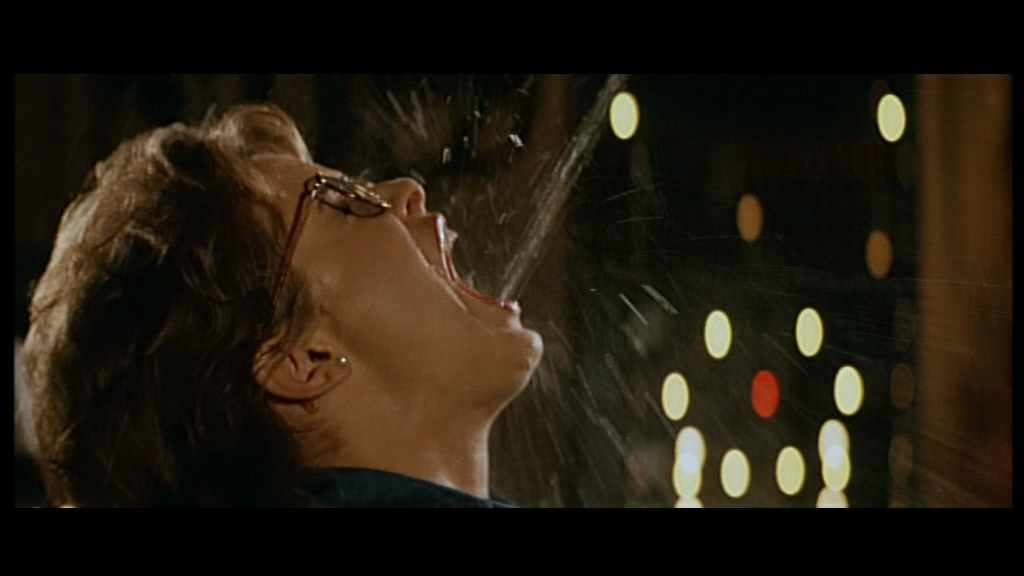
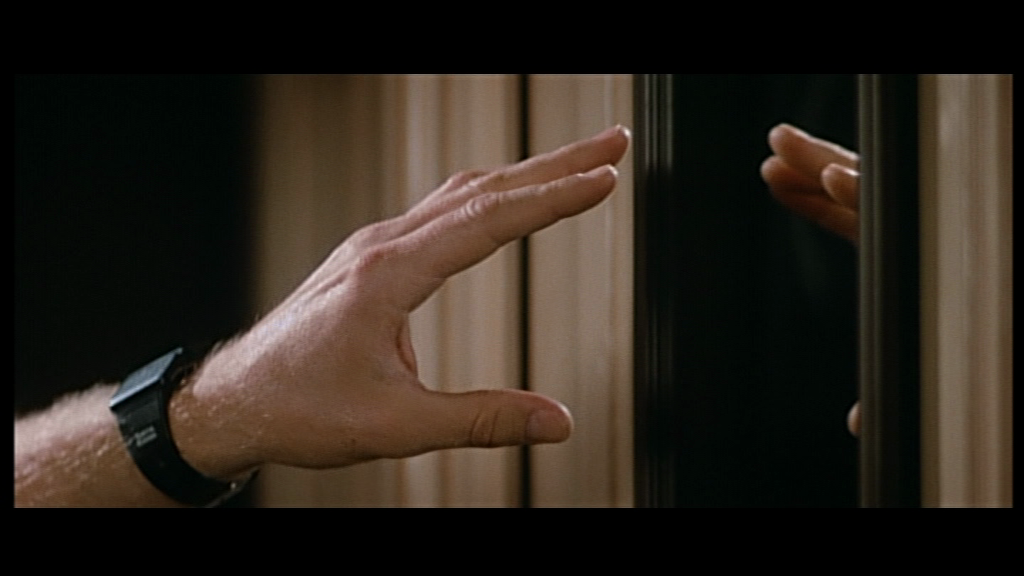
THIS MAN ...


... WATCHES THIS ...


... AND SO, IN TURN, DO YOU


So not exactly Pixar, then.  And that’s without even mentioning the soft-focus Asian porn featuring wooden dildos hidden in dolls; James Woods inserting a video cassette throbbing with sexual energy into a vaginal slit in his stomach after kissing and caressing his erotically pulsating television set; and Blondie starlet Debbie Harry putting out lit cigarettes on her breast and cajoling Woods into piercing her ears with a dirty needle during sex on the living room rug.

How can you recommend this unique and enthralling movie without making it sound like the worst kind of exploitative sleaze?  Consuming horror cinema does not, of course, actually make you a depraved lunatic, and similarly the creators of such works are (not necessarily) salivating perverts, either.  In fact, it’s become almost a cliché to hear how a director is nothing like his oeuvre:  John Woo apparently hates the sound of gunfire and deplores violence, and David Lynch was called a ‘nice, normal guy’ recently by Chris Isaak on British TV (amusingly, Isaak also stated on the same show that the extremeness of an artist’s work tends to be inversely proportional to his deviancy, meaning that purveyors of kiddie-centric innocence are likely the biggest sickos of the lot).  And David Cronenberg himself comes across as intelligent, erudite and somewhat bashful in interviews.

CRONENBERG:  NOT AS SCARY AS HE LOOKS

Ironically, it is often in controversial ‘extreme’ flicks that the most interesting allegorical cinema emerges.  George A. Romero’s …Dead movies each represent characteristics of the society of the time in which they were made; The Texas Chainsaw Massacre was Tobe Hooper’s venomous reaction to the US’s callous attitude regarding the atrocities of the Vietnam war; Cannibal Holocaust, arguably the most disturbing film of all time, contains a thoughtful 'who are the real savages here?' conundrum amongst its animal sacrifice, castration and native rape.  

The question is, since you can waffle pseudo-intellectual claptrap about pretty much anything (I still remember agonisingly trying to stretch my undergraduate analysis of A Midsummer Night’s Dream to 4000 painful words) how do you identify the texts with genuine depth? 


A COMMENTARY ON REAGAN-ERA AMERICA, PERHAPS?

The answer, for me, is strangeness.  Some films are, of course, simply cheap sleaze and have nothing to say, existing just as exploitative vessels for sex and violence.  Which is fine and often a lot of fun, but such titles can only be appreciated on the basest level.  Even the most desperate Media Studies student would struggle to sit through Friday the 13th Part VIII: Jason Takes Manhattan, for instance, and see anything more than a simple stalk ‘n’ slash affair – the series gains no further credence through relocating Jason Voorhees from the backwoods to the big city (he’s actually on a ship for most of the movie, but there’s no nautical relevance, either).  It’s gory, but straightforward; brutal, but conventional.

Contrastingly, when you watch Videodrome, or even hear a description of it, the "WTF?" moments come thick and fast.  Some people do watch it and are left cold, considering it nothing but a crazy and disturbing mess.  But they’re wrong; there is a lot more going on under the gory, trippy surface – it’s just not easy to put your finger on exactly what that is.  I first saw the movie when I was 14 and have re-watched it many times since, and its exact meaning still eludes me.  The dangers of watching too much TV?  How life as we know will eventually become just a reproduction of what we see on television?  The corrupting influence of those who hold power and influence over us, how they keep us in check through subliminal messages that amount to mind-control?  The film’s famous closing line is ‘Long live the new flesh’ – so is it a call to independence and the transgression from mass obedience to individual freedom?

OR AN ODE TO HAVING ENOUGH ASHTRAYS IN YOUR HOME?
 
I’ve never quite been sure, just like the viewer never really knows how much is real and how much is just in Woods’ mind after he first watches Videodrome in the film’s early stages.  But to those who are left frustrated by the movie’s ambiguity, I say this:  there can be a satisfaction in letting go of the need to understand what you are experiencing and simply going with it.  Don’t fight your confusion, embrace it; hell, our protagonist is baffled for most of the duration, so it’s not as if the bewilderment alienates us from his journey.  Art doesn’t have to always be grasped on a rational level, and since it’s quite obvious that the strangeness meter is up to eleven in this film and that Cronenberg is no mere hack on the level of Eli Roth (Hostel I and II) or Leigh Whannell (the Saw saga), then just embrace the weirdness and take it all in.  We human beings aren’t meant to understand everything, after all.  

Long live the new flesh!  (Whatever the hell that actually means.)  *****

Sunday, 15 April 2012

10 Best Horror Movie Scores


This list of spine-tinglers is compiled in order of release.


Psycho  (1960) – Bernard Hermann


Few pieces of film music are so utterly attached to their source as this classic.  That ree ree ree! of the knife stabbing is idiosyncratic and, together with masterful editing, helps the audience to fill in the blanks of what Hitchcock couldn’t show in the shower, resulting in an experience more traumatic than a thousand explicit Saw efforts.


The Exorcist  (1973) – Mike Oldfield


Oldfield's tubular sound creates eerily satanic church bells, ringing as you're chased through the courtyard at midnight by something that never actually shows itself but will never stop stalking you – and so is all the more terrifying.


The Omen  (1976) – Jerry Goldsmith


Less subtle than The Exorcist, but an equally unnerving religious-tinged bombast.  The son of the Devil is here, and he’s not going to obediently go and sit on the naughty step.


Jaws  (1975) – John Williams


No movie since Psycho has made people so afraid to be around water.  Amongst the most recognisable themes of all time; hell, the opening two notes alone are iconic...


Halloween  (1978) – John Carpenter


Escalating dread.  That's the feeling you get watching John Carpenter’s master work, not least because of its peerless score.  Carpenter’s music is often dismissed by purists as a catalogue of simplistic synthesizer-reliant relics; I have a place in my heart for all of them, but even the biggest music snob must bow down to the Halloween theme.


Alien  (1979) – Jerry Goldsmith


Ridley Scott’s upcoming return to the Alien universe has been getting a lot of people very excited.  If he can deliver an experience that matches one tenth of the crippling, isolated, no-one-will-ever-hear-your-screams-let-alone-care terror of Goldsmith’s score for the one that started it all, than Prometheus will have been worth the wait.


The Shining  (1980) – Krzysztof Penderecki 


This score hints at the isolated, maddening horror the Torrence family are letting themselves in for at the Overlook hotel, with undertones of the Native American burial ground that someone decided to build a hotel on.  Not such a great investment when caretakers can’t stop hacking up their families.


The Thing  (1982) – Ennio Morricone


The best John Carpenter score that he never wrote.  The definition of minimalism, each du-dum throb mimics the audience’s heartbeat as they experience the unease of being in a hot terror sweat whilst trapped in a frozen, barren hell.


A Nightmare on Elm Street  (1984) – Charles Bernstein


Memorable, obliquely spine-tingling with a taunting undercurrent – this vastly underrated score is just like Freddy himself.  One of the many mistakes the turgid remake got wrong was abandoning it.


The Fly  (1986) – Howard Shore


Shore manages to capture the wonder of scientific discovery, the empowering catalyst of love, the doom of fucking with nature and the operatic tragedy that combining these elements propagates.  Impressive stuff.


See also:

5 Horror Remakes That Do the Originals Justice

5 of the Very Worst Horror Remakes 

10 Best Action/Adventure Movie Scores


Sunday, 8 April 2012

Prince of Darkness (1987)

Starring: Donald Pleasence, Victor Wong, 
Jameson Parker, Lisa Blount, Dennis Dun

Directed by: John Carpenter

Written by: John Carpenter

Duration: 1hr 42mins

Rating: 4.5 out of 5


Prince of Darkness is a personal favourite that I've seen more times than I can recall.  And yet I’m actually reluctant to re-watch my most revered movies too often – I always want to recapture at least some of the joy of that first viewing, when I was utterly absorbed in the story and not mentally ticking off what happens next.

FOR SOME MEN, EVERY MONTH IS MOVEMBER
This is ‘familiarity fear’:  the fact that you love the film and know it back to front makes you want to watch it again, but at the same time you’re afraid to because you’re worried it’s too familiar, and that watching it whilst you still remember it so well will render the experience inferior.  I try to leave at least two years between viewings of flicks like this, but sometimes you inadvertently catch a bit on TV, which re-familiarises you with the film and pushes the process back.

SCIENCE VS RELIGION DONE BETTER 
THAN ANY DAN BROWN ADAPTATION
Sometimes the best solution to this phenomenon is to watch the film with someone who’s never seen it before.  Introducing one of your favourites to a new viewer lets you experience it through new eyes, and vicariously re-experience some of that first-time wonder.


So when I had the urge to watch Prince of Darkness again after a long gap, I did so with my girlfriend.  She has stated many times that she ‘doesn’t like scary movies’, but hey – I’ve sat through Kate Hudson romcoms with her, which is a horrific experience for me, and aren’t relationships supposed to be about compromise?

HAPPY EASTER!
Anyway, I put the film on and we’re confronted by the prerequisite eerie John Carpenter opening (featuring his best horror score, after Halloween).  My dearest gets into the atmosphere, as an elderly priest's death places an ancient key into Father Loomis's (Donald Pleasence) possession and he visits Victor Wong's physics professor for assistance.  But things go downhill swiftly when the hero of the piece, Jameson Parker, struts onto the university campus.  My first-time viewer is unconvinced of the protagonist's status as a grad student (Parker was 33 at the time) and, worse still, his full-on 80s moustache raises titters.  I'm fearing that my promise to expose her to what I dubbed ‘one of the scariest movies ever’ is going to be laughed off.

Parker and his fellow science majors are summoned by Pleasence and Wong to a cavernous church, where they’ll spend the weekend investigating a mysterious vat of green liquid that looms in the building’s previously locked basement.  Things are simmering away nicely, as the bafflingly convoluted backstory (the vat contains the devil’s son; Christ was really an alien; there’s been a church cover-up for centuries) mixes in with a religion vs science debate between the father and professor and the gradual build-up of unease brought on by the creepy vagrants who are gathering zombie-like in increasing hoards to stand around outside the church and stare at it. (‘Is that Alice Cooper?’, my beloved asks, rightly identifying the rock legend.)

I’m enjoying the movie, as is she, but it does seem rather tame, and a tad slow.  But things soon kick up a notch:  one character has a run in with the erstwhile dormant vat that leaves her demoniacally posessed; Cooper attacks a nerdy scientist in an alley; other members of the group start turning on each other; and (in my favourite moment) one bearded guy collapses into a pile of bugs, seconds after delivering the following in a demonic monotone: “I’ve got a message for you.  You’re not going to like it:  'Pray for death.'”

ELEMENTS OF A SCARY/WEIRD MOVIE: 
 A HUGE GREEN TEST TUBE CANISTER THING…

... THAT DRIPS UPWARDS...

… AND IS AN IMPROMPTU DRINKING FOUNTAIN…

... THAT TURNS RATIONAL SCIENTISTS 
INTO MURDEROUS DEVIL-WORSHIPPERS…

... AND CAUSES WORMS STICK TO WINDOWS...

 … AND COMPUTERS TO DISPLAY OMINOUS TEXT…

… AND PEOPLE TO TURN INTO COCKROACHES…

… AND ALICE COOPER TO STAB A COMPUTER 
TECHNICIAN TO DEATH WITH A BROKEN BICYCLE 

Throughout these happenings, I gradually notice a change in my viewing partner.  The quips about the dated fashions and hairdos die down, the giggles at the archaic computers stop, the shuffling and whines of ‘when is something going to happen?’ cease.  And what replaces all this is a prone figure, staring wide-eyed at the screen, blanket pulled up tight, totally involved; the only movements are winces at the gruesome bits and a quick duck under the covers to avoid the scariest parts.  And watching this, surpressing my smirk so as not to be mean, I remember how I felt the first time I watched it, more than fifteen years ago.


THIS IS A GREAT ENDING... TRUST ME
Because this is a scary movie.  There’s no use in having a slow build-up if there’s no climax, but boy does Prince of Darkness deliver in its third act.  Dawn approaches, and those who are still human hide out from their possessed colleagues as the shit really starts to make the fan's acquaintance, with the demon of the title deciding he wants break on through to our world, leading to a good vs evil face-off that notches the tension up to a near-unbearable level.  You want high stakes?  How about the end of the bloody world?  And it all comes to a head with the best Carpenter ending; better, even, than The Thing.  Phew!

Next time, I’ll put on The Shining.  Well, I’ll wait for her to recover from this one first…  ****1/2

Thursday, 15 March 2012

The Fly (1986)

Starring:  Jeff Goldblum, Geena Davis, John Getz

Directed by: David Cronenberg

Written by: David Cronenberg, Charles Edward Pouge

Duration: 1hr 36mins

Rating: 5 out of 5


BEAR WITH ME, I AM GOING SOMEWHERE WITH THIS 
Ronseal’s ‘It does exactly what it says on the tin’ was recently voted amongst the best ever advertising slogans on British TV.  This starkly frank and hyperbole-free statement gets right to the root of what we human beings are drawn to – the truth.  If it says it will protect your garden fence from the elements for up to five years, then you want that fence to be protected for the stated period.


Is this the same for cinema?  Do we want our expectations to be totally fulfilled – is that what makes a movie ‘good’?  If the answer was as simple as that, then romantic comedies would be the pinnacle of filmmaking.  But on the other hand, if every film was like Eraserhead, defying all convention and explanation, then we’d soon all be as barking as a David Lynch creation.

AN UNDERRATED MASTERPIECE?
DO YOU WANT THIS TO BE YOU?


No, for a film to be truly successful, it must skilfully walk a tightrope between giving you what you want and surprising you with something unexpected.  I’m usually reluctant to use the ‘p’ word, but I consider The Fly to be a perfect movie.  It both does exactly what it says on the tin and gives us so much more; it’s a superb man-accidently-turns-into-a-fly gory horror flick, but is also intelligent, emotional, tense, dramatic, romantic, funny and unforgettable.  


The Fly is ostensibly a monster movie, a modern-day retelling of Frankenstein mixed with Kafka's Metamorphosis, one where the doctor and the monster are one and the same.

DRY ICE AIDS THE TELEPORTATION PROCESS, YOU SEE... 
But Cronenberg's movie is elevated onto a higher platform by one part of the anatomy that these earlier tales are not known for: the heart – or ‘the flesh’, as the movie puts it.  Cronenberg is known as a cold, intellectual, somewhat intimidating surgeon of a director (his serial-killing psychiatrist acting turn in Cliver Barker's Nightbreed did little to negate this), and yet the romance he chronicals here gives the film a real emotional core that makes its story genuinely heart-breaking.  The Canadian presents a relationship that is intense, erotic and, ultimately, adult – which, for my money, makes it far more effective than the diluted and chaste portrayals from more lauded ‘people’ directors such as Steven Spielberg. 


BEING 'BUG-EYED' WAS AN ADVANTAGE AT AUDITION
It effectiveness is in no small part down to the chemistry of real-life couple Goldblum and Davis (as Veronica, the journalist whose interest Brundle's work on teleportation piques).  Goldblum should have won an Academy Award for Best Actor for his stunning performance.  He embodies a jittery, bashful intellect; charmingly naïve, endearingly eccentric.  With his bulging eyes and long limbs, the actor is somewhat insect-like to begin with, and as the layers of make-up are piled on and the tics increase his humanity remains and he manages to cut a compelling, sympathetic figure from start to end.

The Fly’s script is tighter than a kettle drum, with a typically Cronenbergian brief running time and a mere three main characters, Veronica’s boss and jealous ex Stathis Borans completing the triangle.  It’s contains more humour than the director has delivered before or since, with ironic observations (Brundle complains of motion sickness in a car), wit (“What are you, a bodybuilder?” gasps a floozy Brundle picks up in a bar.  “Sure I build bodies,” he replies. “I take them apart then I put them back together again”) and one exchange that always makes me laugh out loud: “I’m onto something big, huge!” Veronia gushes to Stathis after seeing Brundle’s work. “What, his COCK?!” her former lover spits.

IN OTHER WORDS ...

... 'YOU'RE FUCKED'

Much has been said about the parallels between Brundle’s deteriorating condition and ‘80s zeitgeist pandemic Aids.  Certainly you could latch onto this theory, but Cronenberg has always insisted that the movie is about the ultimate disease:  ageing.  “What’s happening?” laments Brundle as his transformation takes hold.  “Am I dying – is this how it starts?”  The movie appears to be a Michael Crichton-esque cautionary tale of man meddling with nature, which of course it is, but it’s really about our helplessness against the finiteness of life; we are all born with a body that will both grow and work towards its ultimate destiny:  to decay and die.

So, not pretty (make up wiz Chris Walas did get the Oscar he deserved, and went on to helm the silly but fun The Fly II) and not optimistic (though life does go on, in the shape of Veronica’s pregnancy) but hey – most great truths aren’t pleasant.  But, just like The Fly, they are essential.  *****

Monday, 13 February 2012

5 of the Very Worst Horror Remakes

Following on from my five respectable horror remakes feature, here is a list of five of the worst (much harder to round down to this small number).

1.  A Nightmare On Elm Street

The original (1984)
Seven sequels, a TV show, a tribute song by Jazzy Jeff and the Fresh Prince...  all have served to mask the impact of the first he’ll-get-you-when-you-sleep hit.  A genius concept, played with a grim menace but never taking itself completely seriously, the movie gave us one of the screen’s true horror icons in knife fingered Freddy Kruger.  Memorable images came thick and fast: the marshmallow stairs; Freddy’s tongue coming out the phone (“I’m your boyfriend now, Nancy!”); a crop-top wearing Johnny Depp being eaten then spat out by his own bed.

The remake (2010)
As demonstrated by The Amityville Horror and The Texas Chainsaw Massacre remakes, Platinum Dunes can re-imagine with the best of them: crank up the dread, lay on the gore and tie it all together with attractive teens brooding around to an unsubtle string score.  But here the po-faced style falls totally flat.  An Elm Street film needs a careful hand that acknowledges the ludicrousness of its high concept without skimping on the scares – sadly, music video veteran Samuel Bayer manages to make a film about people trying to stay awake as dull as a sleepless night in front of 4am Countdown repeats.  This despite the commendable efforts of Jackie Earle Haley as Kruger. 


2. Halloween

The original (1978)
A cinematic thesis on creating suspense and mounting tension, John Carpenter’s masterpiece went on to define the slasher genre to this day.  It's up there as one of the scariest movies ever made (alongside The Shining and The Exorcist).

The remake (2007)
Rob Zombie needs to stop making movies before I insert a skewer into my ear and make a kebab out of my brain. And feed it to him.  Witless, charmless, scare-less, hopeless, awful, terrible... and – where's that thesaurus? – ah that’s the one: ‘shit’.


3. The Fog

The original (1980)
With his second stab (snark) at the genre, Carpenter delivered a good old-fashioned ghost story as a sleepy port town is terrorised by a malevolent mist from the sea.  Eerie, tense, brilliant.

The remake (2005)
One hundred minutes and zero scares – hardly an exercise in value for money.  An ending that stays with you for all the wrong reasons.


4. The Wicker Man

The original (1973)
 

Ace Brit horror that pitted stuffy Edward Woodward and his traditional Christian values against an on-form Christopher Lee’s gang of heathen pagans on a remote English island.  And it featured Britt Ekland dancing around a bonfire starkers.  Bonus.

The remake (2006)
 

Rumour has it that recent Nicolas Cage script choices have been motivated by a need to pay back the IRS – what, the man who made Next, Bangkok Dangerous and National Treasure: Book of Secrets?  This crapfest is the strongest evidence for the prosecution.  The mock trailers on YouTube are, however, hilarious. “Not the bees!”


5. Psycho

The original (1960)
 

Hitch reached his considerable zenith with this hugely influential masterwork that cannot be faulted.  OK, the first act could have done with a trim.

The remake (1998)
 

A bafflingly pointless shot-for-shot atrocity.  Unlike, say, Dawn of the Dead, everything it adds makes it worse (Norman Bates wanking?).  Vince Vaughan is no Anthony Perkins.  Anne Heche is no Janet Leigh.  Gus Van Sant is no Alfred Hitchcock.